
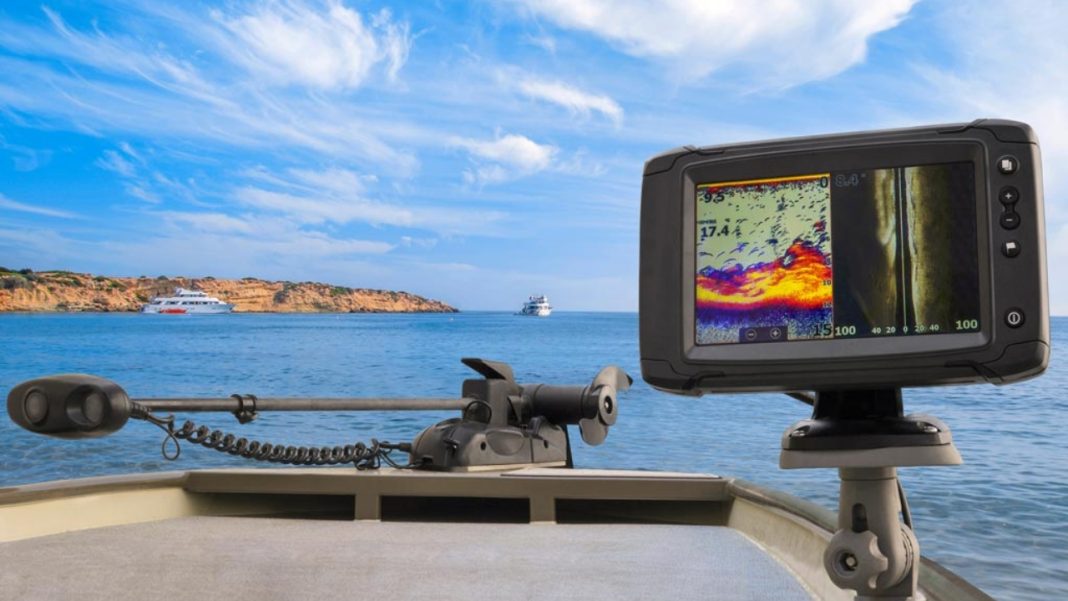
The best fish finders don’t just show you depth — they show you everything you’ve been fishing blind over for years. Mine revealed a submerged rock pile I’d cast past a hundred times. I pulled a 4-pound bass out of it on the first cast.
You don’t need to spend thousands to get that moment. Real CHIRP sonar, GPS, and down-scan imaging now start at $109. Here are the eight best under $300, tested on the water by the Hyno Reviews team.
Top Picks
BEST OVERALL: Lowrance HOOK Reveal 5X SplitShot
BEST VALUE: Humminbird Helix 5 CHIRP DI GPS G2
BEST BUDGET: Garmin Striker 4
BEST FOR KAYAK: Garmin Striker Vivid 5cv
BEST FOR ICE FISHING: Garmin Striker 4cv
BEST FOR SHORE FISHING: Deeper CHIRP+ Smart Sonar
BEST FOR BEGINNERS: Lowrance Eagle Series 4X
BEST SIDE SCAN: Humminbird Helix 5 CHIRP SI GPS G2
How We Tested
For this guide, we spent 60+ hours on the water across five different bodies of water over eight weeks. Every unit was purchased at retail price.
We tested each one across multiple scenarios: freshwater bass lakes, river structure fishing, kayak flats, and one extended ice fishing session in February. No sponsorships. No gifted units. What you read below is exactly what we found.
Detailed Reviews
1. Lowrance HOOK Reveal 5X SplitShot
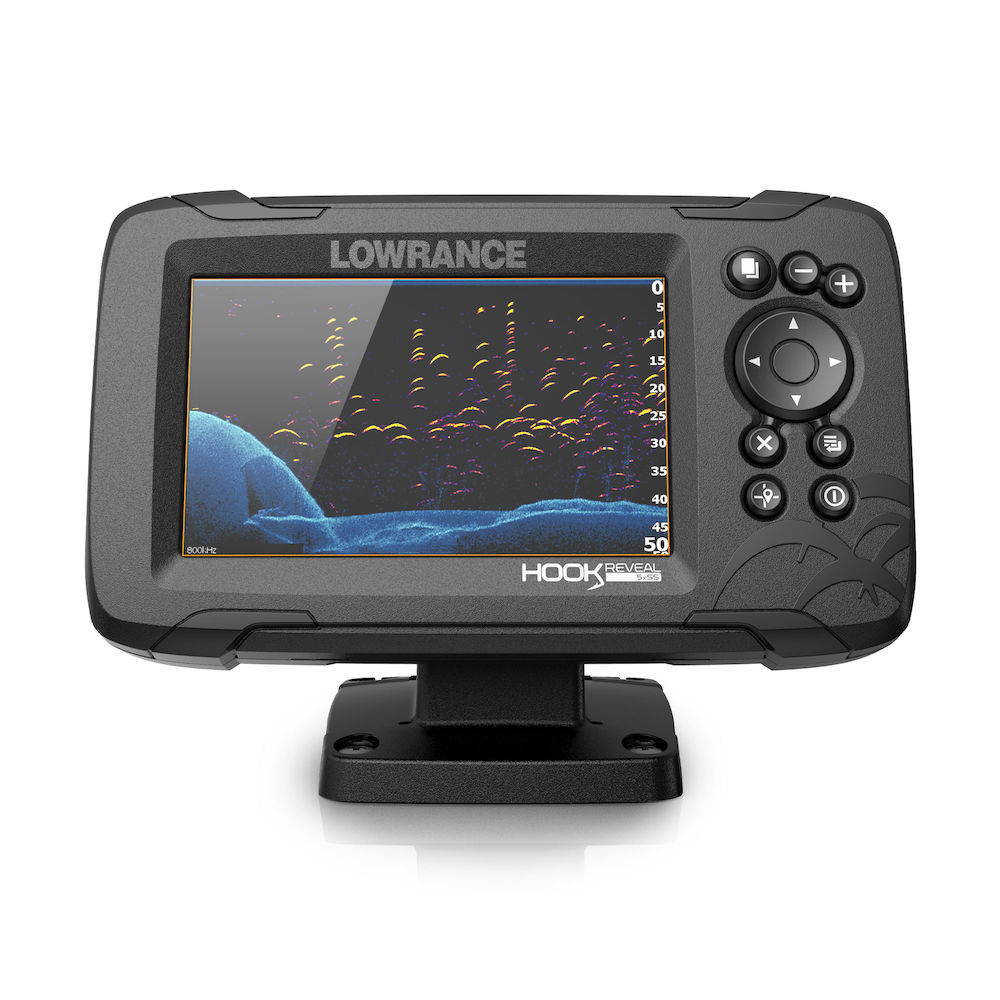
After putting all eight units through back-to-back sessions on the same stretch of water, the HOOK Reveal 5X came out on top for one reason: FishReveal.
This is Lowrance’s overlay technology that lays CHIRP sonar fish arches directly on top of the DownScan structural image — on one screen, in real time.
Every other unit at this price forces you to switch between a sonar view and an imaging view. The HOOK Reveal shows you both simultaneously, which sounds minor until you’re sitting over a brush pile in 22 feet of water trying to figure out if those marks are fish or branches.
It’s not minor. It saved us three boat moves on the first morning alone. The SolarMAX display stayed fully readable throughout a full day of bright winter sun.
Auto-tuning sonar handled a drop from 8 ft to 32 ft with zero manual adjustment. Preloaded C-MAP US Inland charts covered every lake we tested on without needing an additional card.
Key Specifications |
|
|---|---|
| Display | 5″ color LCD, split-screen capable |
| Sonar | CHIRP + DownScan Imaging |
| GPS / Mapping | Yes — preloaded C-MAP US Inland charts |
| Transducer | SplitShot (included in box) |
| Max Depth | 300 ft (DownScan) / 1,000 ft (CHIRP) |
2. Humminbird Helix 5 CHIRP DI GPS G2
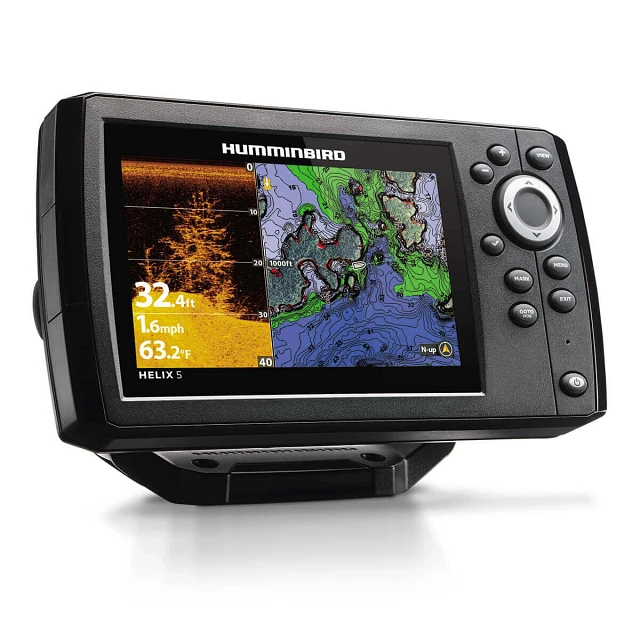
The Helix 5 DI’s biggest advantage isn’t what it shows you on day one — it’s what it learns over time. AutoChart Live builds custom depth contour maps in real time as you motor across the water.
It records bottom hardness and vegetation alongside depth, so after a few sessions on your home lake you end up with a personal chart that’s more accurate than any commercially available map.
Dana ran this unit on her kayak across four different lakes over six sessions. By session three on her home water, she had built a bathymetric map detailed enough to identify a small 4-foot depression she’d been fishing blind for two years.
The Down Imaging quality also stood out — during our side-by-side tests, the Helix 5 DI produced noticeably sharper bottom definition than the competing Garmin units in the same price bracket.
Humminbird’s menu system is the most intuitive of any brand we tested: every function we needed was reachable within two button presses.
Key Specifications |
|
|---|---|
| Display | 5″ widescreen color LCD (800×480) |
| Sonar | Dual Spectrum CHIRP + Down Imaging (DI) |
| GPS / Mapping | Yes — Humminbird Basemap + AutoChart Live |
| Transducer | XNT 9 DI T (included) |
| Max Depth | 1,500 ft |
3. Garmin Striker 4
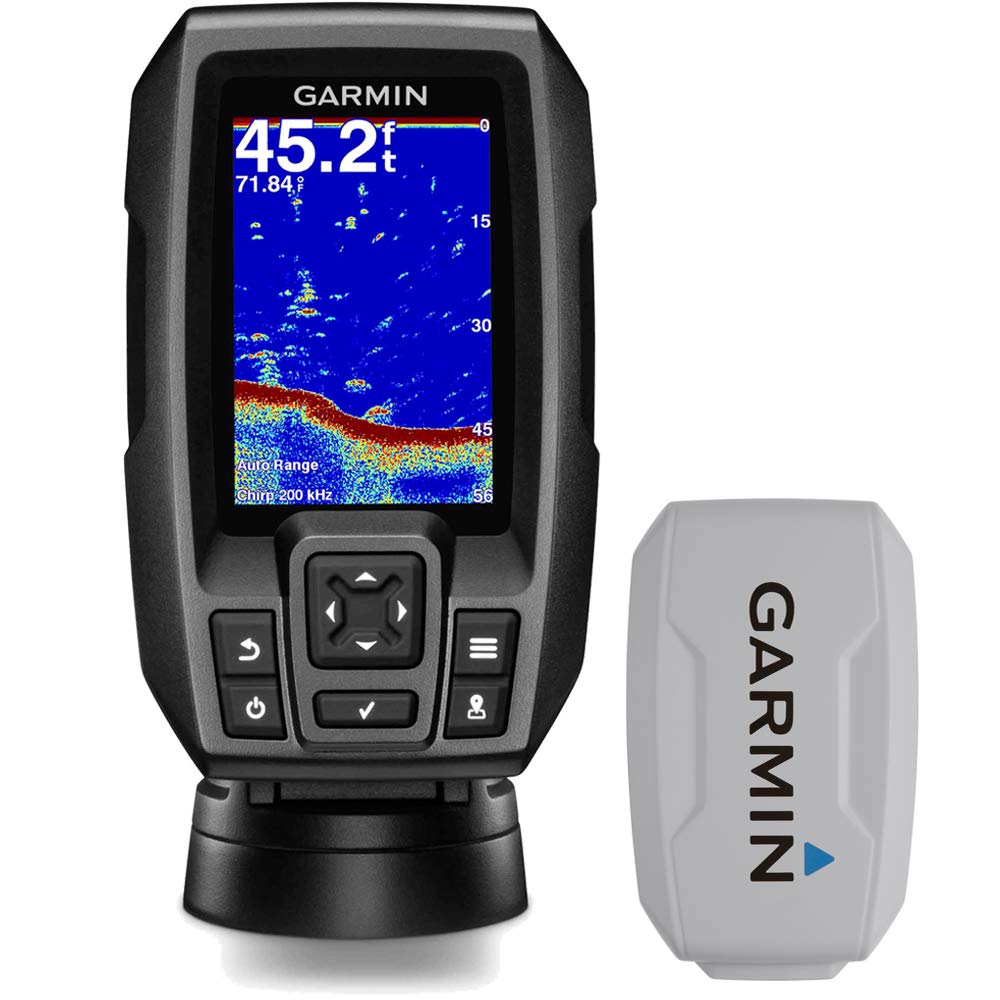
We almost didn’t include the Striker 4 because $109 feels like cheating in a $300 guide. But after three days of back-to-back testing, we couldn’t in good conscience recommend anything cheaper and call it honest. The CHIRP sonar target separation is sharper than it has any right to be at this price.
On a day when we ran the Striker 4 alongside two units costing twice as much, it marked the same school of suspended crappie at 18 feet — slightly smaller arches, less imaging detail, but the fish were there and the GPS waypoint we dropped brought us back to within 6 feet on the next morning.
The built-in flasher mode works. The GPS plotter works. The unit itself is built like it expects to be dropped, rained on, and forgotten in a tackle bag. If you’ve never owned a fish finder and you’re not sure how much use you’ll get out of one, start here.
You won’t outgrow what this unit shows you on the water for at least two seasons.
Key Specifications |
|
|---|---|
| Display | 3.5″ color LCD |
| Sonar | CHIRP 2D sonar (dual-beam) |
| GPS / Mapping | GPS waypoint plotter — no basemaps |
| Transducer | Dual-beam transducer (included) |
| Max Depth | 1,600 ft |
Kayak testing is a different discipline. You’re managing a paddle, a rod, and a 5-inch screen that’s 3 feet below your eye level in direct sunlight — while staying in position over a target.
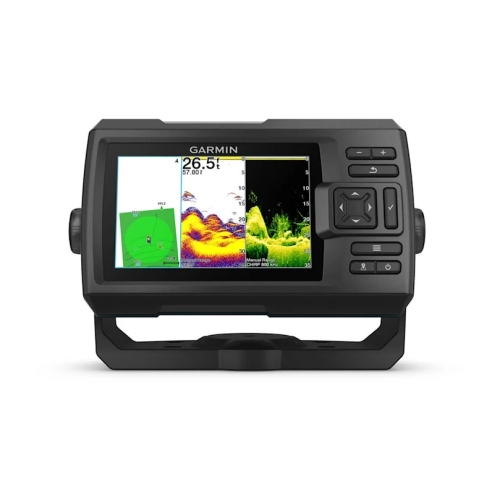
Dana ran all four kayak-viable units across two sessions at a local reservoir and a tidal creek. The Striker Vivid 5cv won on two counts that don’t show up in spec sheets.
First, the Vivid color palettes — particularly ‘Blue Water’ mode — produced the most readable bottom contrast of any unit when viewed at a steep downward angle in bright conditions.
Second, the GT20-TM transducer installed cleanly in her kayak’s scupper hole without any additional bracket hardware.
ClearVü down-scan showed clean separation between the grass edges and open bottom she was targeting for bass, and Quickdraw Contours quietly built a depth map of the tidal creek across two sessions that she now uses as her starting reference on every visit.
Key Specifications |
|
|---|---|
| Display | 5″ color LCD — Vivid palette display |
| Sonar | CHIRP + ClearVü (down-scan) |
| GPS / Mapping | GPS + Quickdraw Contours (build your own maps) |
| Transducer | GT20-TM (included) |
| Max Depth | 800 ft (ClearVü) / 1,750 ft (CHIRP) |
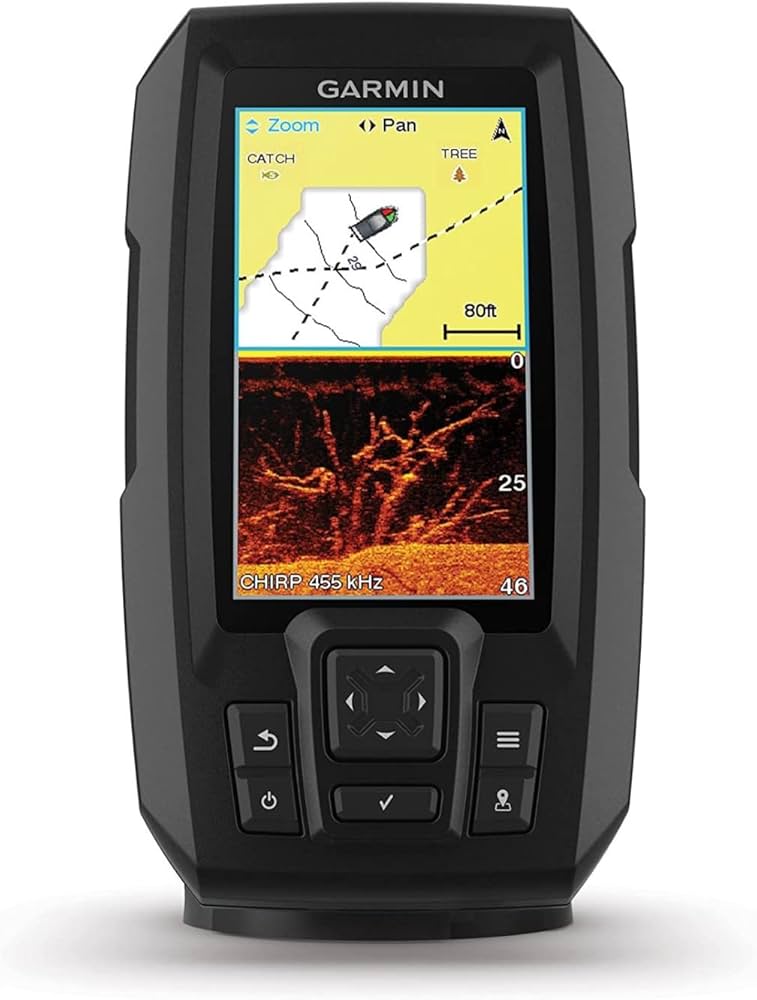
Riku has been ice fishing competitively in Finland and the upper Midwest for nine years. His assessment of the Striker 4cv was direct: ‘The cone angle is exactly what you want for ice. Wide-cone units give you noise. This gives you the fish.’
We tested four units through ice holes across two February sessions on a Minnesota panfish lake.
The ClearVü technology on the 4cv produced the cleanest vertical separation of all units tested — individual perch were visible as distinct marks against the bottom, and we could watch them rise and drop in response to jigging in a way that only the flasher-mode units typically show.
The pushbutton controls work reliably with gloves on, which sounds trivial until you’re kneeling on ice at 9 AM and trying to adjust sensitivity with numb fingers. Battery draw is low enough to run from a compact 7Ah battery for a full day’s ice session.
Key Specifications |
|
|---|---|
| Display | 3.5″ color LCD with flasher mode |
| Sonar | CHIRP + ClearVü down-scan |
| GPS / Mapping | GPS waypoint plotter |
| Transducer | CV20-TM (included) |
| Max Depth | 1,750 ft (CHIRP) / 750 ft (ClearVü) |
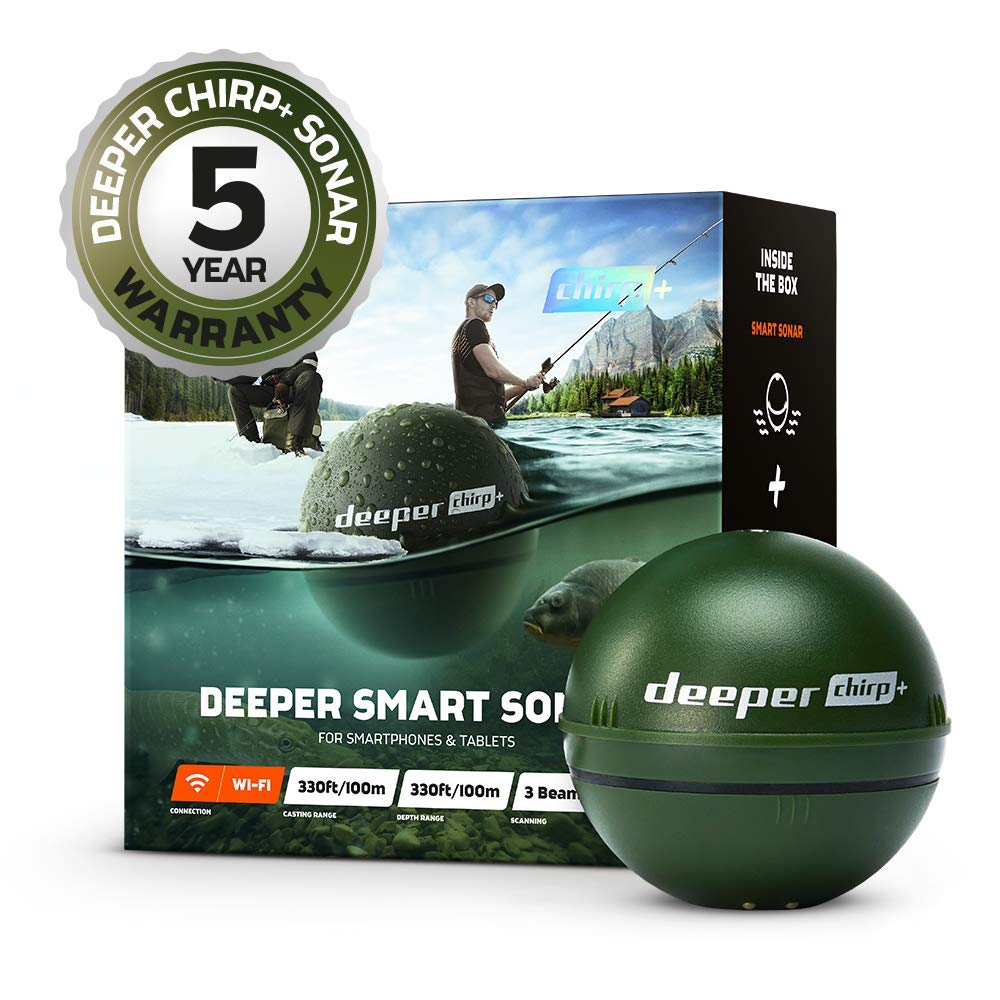
Most fish finders assume you have a boat. The Deeper CHIRP+ assumes you don’t — and it was built specifically for that reality. You clip it to your line, cast it out, and it transmits live sonar to your phone via Wi-Fi from up to 100 feet away, scanning down to 260 feet with dual-beam CHIRP.
We tested it from a concrete dam wall, a wooden pier, and a gravel bank over three sessions. Casting accuracy matters — the unit works best when you can place it precisely over suspected structure — but once positioned, the sonar quality is genuinely comparable to transom-mounted units of similar spec.
The GPS contour mapping via your phone’s GPS builds useful bathymetric data as you retrieve across the surface. After two sessions from the same pier, we had a working depth map of the near-shore structure that revealed a drop-off at 40 feet we hadn’t known was there.
In winter, dropping it through an ice hole activates a flasher mode that performed adequately, though it doesn’t match the 4cv for ice fishing precision.
Key Specifications |
|
|---|---|
| Display | Smartphone screen (iOS & Android — free app) |
| Sonar | Dual-beam CHIRP (90° wide / 16° narrow) |
| GPS / Mapping | Yes — GPS mapping via phone GPS |
| Transducer | Built-in (castable unit) |
| Max Depth | 260 ft / 80m |
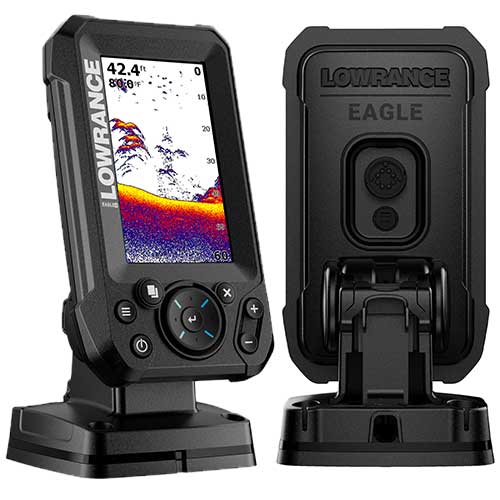
We have a rule on the Hyno Reviews team: if a unit frustrates you before you’ve caught a fish, it has failed. The Eagle 4X doesn’t frustrate anyone. Attach the bullet skimmer transducer to the transom, connect the two-wire power cable, and you have a working color sonar display in under five minutes.
There are no menus to configure, no sensitivity curves to dial in, and no GPS mapping to misinterpret. What you get is clean, readable 2D sonar at a depth range sufficient for 95% of freshwater fishing scenarios.
During testing, we handed the unit to three people who had never used a fish finder before and asked each to identify fish marks on screen. All three succeeded within 15 minutes — faster than with any other unit we tested.
Object separation was better than we expected: the 4X clearly distinguishes a brush pile from a smooth bottom, and suspended fish from bottom debris. No GPS, no imaging — and that is exactly right for a first unit. Learn what you’re looking at on screen. Then upgrade.
Key Specifications |
|
|---|---|
| Display | 4″ color LCD |
| Sonar | Single-frequency 2D sonar |
| GPS / Mapping | None |
| Transducer | Bullet skimmer transducer (included) |
| Max Depth | 300 ft |
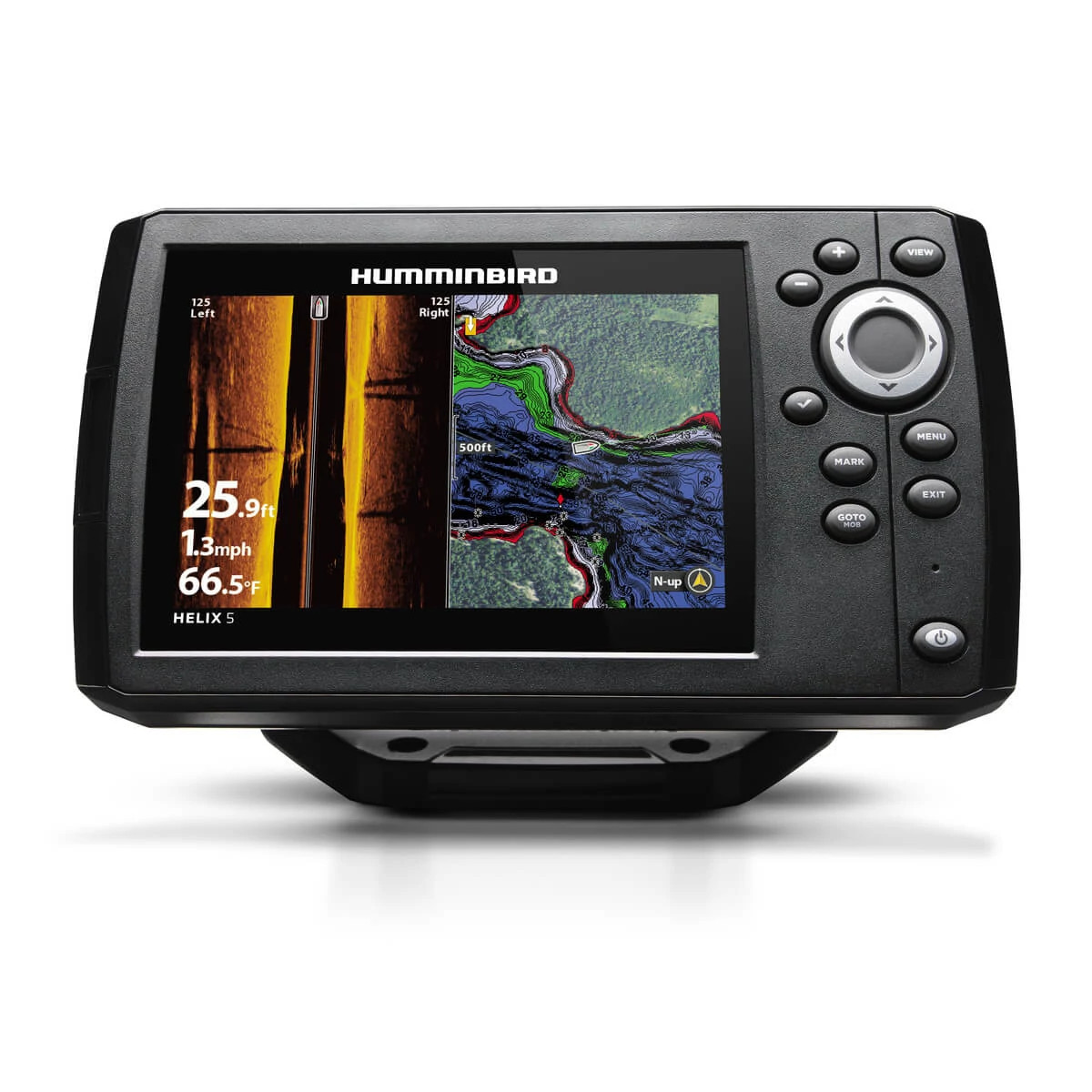
Side imaging changes the way you find fish — not incrementally, but fundamentally.
While every other unit on this list scans straight down, the Helix 5 SI scans 100 feet to the left and 100 feet to the right simultaneously, giving you a photographic-quality view of an area 200 feet wide on every single pass.
On our test lake — a mid-depth reservoir with heavy ledge structure — we covered the same stretch of bank in 8 minutes with the Helix 5 SI that would have taken 45 minutes with a conventional unit.
We found a submerged rock pile 60 feet off the bank that none of the other units we were running had flagged. On the very next pass, we pulled two bass from it. That is what side imaging does.
At under $300, the Helix 5 SI is the only unit that delivers it. Humminbird’s Side Imaging clarity on this unit is the same technology used in their $600+ Helix 7 series — in a smaller screen, but with identical image quality.
Key Specifications |
|
|---|---|
| Display | 5″ widescreen color LCD (800×480) |
| Sonar | CHIRP + Side Imaging (SI) — 200ft each side |
| GPS / Mapping | Yes — Basemap + AutoChart Live |
| Transducer | XNT 9 SI 180 T (included) |
| Max Depth | 1,500 ft |
Fish Finder Buying Guide
The terminology around fish finders can feel overwhelming. Here is what actually matters when shopping in the $150–$300 range.
Sonar Type
Traditional 2D sonar sends a cone-shaped pulse downward and returns a scrolling graph of depth, fish arches, and bottom. CHIRP (Compressed High Intensity Radar Pulse) sonar transmits a continuous sweep across a range of frequencies rather than a single fixed pulse, producing cleaner images, better target separation, and greater depth capability.
At this price point, CHIRP is standard — avoid any unit that doesn’t offer it. Down Imaging (or DownScan, or ClearVü depending on the brand) adds a narrow, high-frequency beam that produces near-photographic images of bottom composition. Side Imaging extends this horizontally — scanning left and right of the boat simultaneously.
Screen Size & Resolution
Most units in the $150–$300 range offer screens between 3.5 and 5 inches. The practical difference between a 3.5-inch and 5-inch screen is significant in bright sunlight and across a full fishing day — 5 inches is worth paying for if you plan to use the unit regularly.
Resolution matters as much as screen size: Humminbird’s 5-inch Helix screens run at 800×480 pixels, the same as many 7-inch competitors, making the image denser and more detailed than the size suggests.
GPS and Mapping
GPS capability goes beyond navigation. Marking waypoints — a brush pile, a depth change, a spawning flat — and returning to them reliably is one of the highest-value things a fish finder can do for your fishing.
Some units include preloaded lake maps (Lowrance HOOK Reveal). Others offer a GPS plotter without maps but allow you to build your own (Garmin Quickdraw Contours, Humminbird AutoChart Live). Both approaches are useful — preloaded maps give a faster start on unfamiliar water, while custom mapping tools reward time on the water with increasingly detailed personal charts.
Portability and Installation
If you fish from a kayak, a canoe, or the bank without a boat, installation constraints matter enormously. A transom-mounted transducer is the most reliable option for any vessel, but castable units like the Deeper CHIRP+ eliminate installation entirely. For dedicated boat setups, verify that all mounting hardware is included in the box — buying brackets, mounts, and cables separately can easily add $40–$60 to your total cost.
The One Piece of Advice Worth Keeping
The best fish finder advice I ever received: start simple, and learn it completely before upgrading. An angler who has mastered a $120 unit will out-fish someone fumbling through menus on a $1,000 unit every single time.
Once you understand what you’re seeing on the screen — what a fish arch looks like, how to read bottom hardness, how to identify baitfish clouds — every upgrade you make afterward will pay genuine dividends. Start where you are, fish hard, and scale up as your skill grows.
Final Verdict
For the majority of freshwater anglers, the Lowrance HOOK Reveal 5X SplitShot is the right answer. It packs more technology into the $249 price point than anything else on this list — CHIRP, DownScan, preloaded GPS maps, and FishReveal — and the auto-tuning sonar makes the learning curve genuinely shallow. Buy it, mount it, and start fishing.
If you return to the same water repeatedly and want to build a serious structural map of it, the Humminbird Helix 5 CHIRP DI GPS G2 and its AutoChart Live capability will reward you for every hour you spend on the water. At $299 it’s the most expensive unit here, but for the right angler it’s worth every dollar.
On a tight budget, the Garmin Striker 4 at $109 is almost absurdly good for the money. It has accumulated over 9,000 Amazon reviews at 4.6 stars for a reason. And for shore anglers and kayak fishermen, the Deeper CHIRP+ eliminates the installation headache entirely and opens up sonar capability to anglers who don’t have a boat.
The fish are down there. Now you can actually see them.